


The central argument of this article is as follows. What happened in that gap can be described as a symbolic suicide: the relinquishing of an established identity. However a symbolic suicide alone does not explain it. The protesters also accepted the real possibility of dying. The term for that is what Huey P. Newton called a revolutionary suicide. My claim is that symbolic suicide becomes revolutionary suicide when the protesters are “deprived of human dignity, crushed by oppressive forces and denied their right to live as pro und and free human beings”, and that the paintings are about the moment of passage.
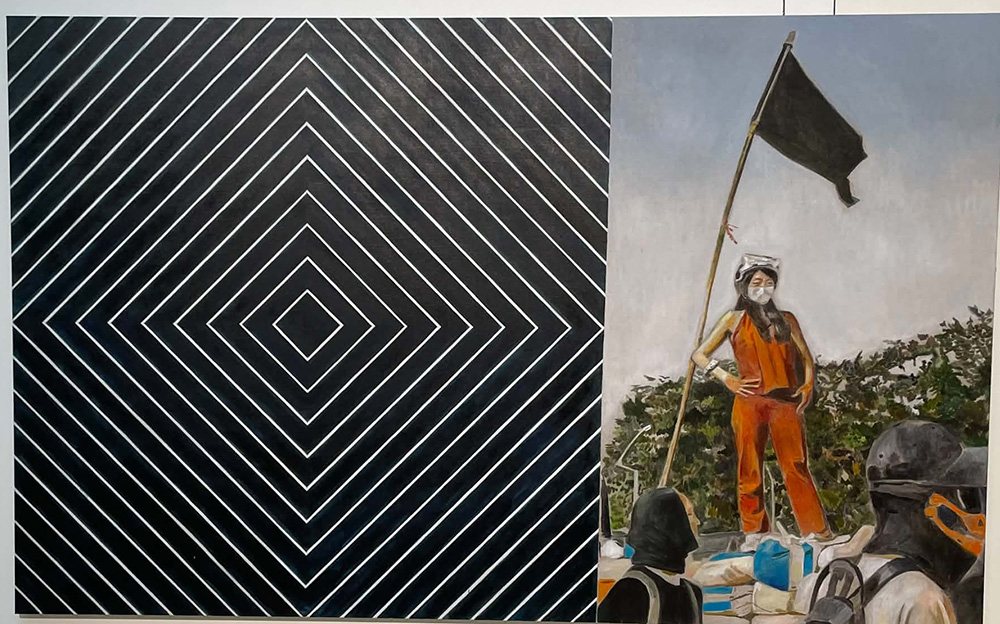
A masked protester stands defiantly in the street of Yangon in the tense week following the February 2021 military coup. She is in the street with a sign. Above her, a rope runs across the road, and from it hang women’s garments: the htamein. Ahead of her stand soldiers with rifles. They will not walk under the rope.
At this moment she is still a citizen. She is petitioning a state. She believes, still, that the state can be addressed.
A few months later, she may be in the jungle. She may have joined the People’s Defence Forces, or allied herself with one of the ethnic armed organisations that have fought the central military for decades. Her name for herself has changed. Her relation to the state has changed. Even her relation to her own death has changed.
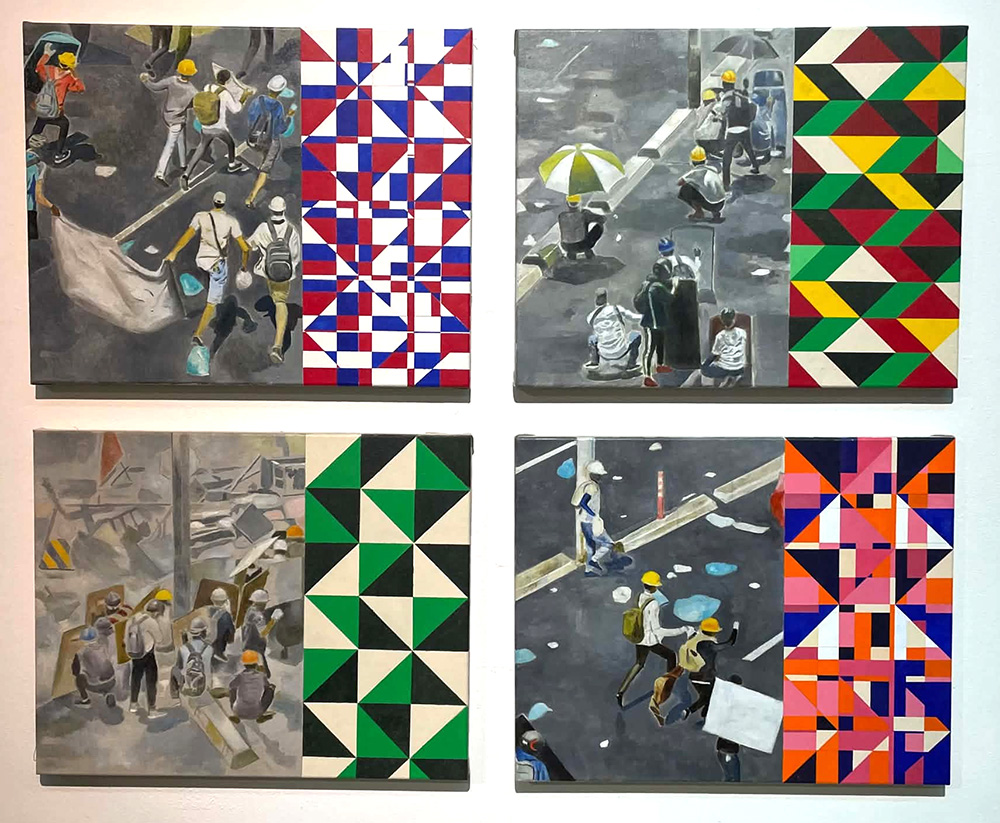
The paintings series People’s Defence Force I-X sit between those two moments. Although the figures are protesters, they have not yet gone to the jungle. I see them at the point where the old identity is already lost and the new one has not yet been taken.
The central argument of this article is as follows. What happened in that gap can be described as a symbolic suicide: the relinquishing of an established identity. However a symbolic suicide alone does not explain it. The protesters also accepted the real possibility of dying. The term for that is what Huey P. Newton called a revolutionary suicide. My claim is that symbolic suicide becomes revolutionary suicide when the protesters are “deprived of human dignity, crushed by oppressive forces and denied their right to live as pro und and free human beings”1, and that the paintings are about the moment of passage.
A long History
Burma sits at the crossroads of three major civilizational spheres: the Indian, Chinese, and Austroasiatic worlds. It has long been a meeting place of diverse peoples, cultures, languages, and belief systems. Throughout its history, different communities have migrated into the region, established their own territories, and competed for power and influence. From time to time, a powerful king succeeded in bringing many of these peoples under a single authority. But such periods of unity rarely lasted. Central authority eventually weakened, rival powers re-emerged, and the country returned to conflict. For much of its history, Burma was a land of competing nations, shifting alliances, and recurring warfare. By the time the British arrived, the Third Burmese Empire was already disintegrating. The British did not invent the Arakan, Mon, or Shan kingdoms, nor did they create the traditional clan structures of the Chin and Naga, the Kachin Duwa system, or the many other forms of ethnic and political organisation that existed across the country. These institutions had deep historical roots, shaped by centuries of migration, settlement, and independent development. They were not colonial inventions; they were established systems of authority and identity that had existed long before British rule.
The British, for the most part, were concerned with extracting wealth rather than building a unified political system across the entire territory. They did not seek to govern every region in the same way. Where they exercised more direct administration, particularly in colonial Burma, their primary objective was to establish the stability necessary to protect commerce and generate revenue.
Following the Second World War, the Bama leadership was presented with a historic opportunity: to build a new country founded on equality, mutual respect, and political consensus. That was the promise embodied in the 1947 Panglong Agreement. It offered the possibility of a Union in which the different nationalities could coexist as equal partners, rather than be forced into submission by a dominant centre.
But that opportunity was squandered. Instead of building a country through negotiation, compromise, and shared political authority, successive Bama-dominated governments chose coercion and military force. Driven by a belief in their own superiority and entitlement to rule, they sought to subordinate the other nationalities rather than recognise their right to equality and self-determination.
The consequences have been devastating. Burma returned to the cycle of domination, resistance, fragmentation, and war that had characterised so much of its earlier history. Today, the situation is even more entrenched. This is not simply a country experiencing occasional rebellions or periodic political upheavals. It is a country trapped in almost continuous civil war.
Burma’s tragedy is not simply that it has failed to achieve peace. It is that the promise of building a union based on equality was abandoned almost at the moment of its birth.
After the 1962 coup led by General Ne Win, many students went into the jungle to join armed resistance. My father was one of them. He joined a rebel army, first the Shan State Independence Army, then the Shan State Army, which was founded by my grandmother, the Mahadevi of Yawnghwe. So the crossing this talk is about has a history. In my family, it has a face.
In 1974, protests broke out over the funeral of U Thant, the former UN Secretary-General, and the military government’s mishandling of it. Led by students and workers, they became a challenge to Ne Win’s dictatorship and to the one-party rule of the Burma Socialist Programme Party.
Then came the 8888 Uprising of 1988, a series of nationwide pro-democracy protests against military rule. In 2007, the Saffron Revolution, led by Buddhist monks and joined by students and ordinary citizens, it was the most significant challenge to the junta since 1988. It was largely nonviolent.
In 2021, the military under Min Aung Hlaing overthrew the elected government and detained civilian leaders, including Aung San Suu Kyi. A massive, nationwide uprising followed. It did not stay within peaceful civil disobedience. It became organised armed resistance, and a full-scale civil war.
What is different in 2021 is the scale and the direction. The turn from nonviolent protest to armed resistance was widespread, and especially strong among Generation Z. They had grown up with exposure to new ideas, to democratic practice, to a relative openness under the National League for Democracy government. And resistance took hold in central Burma. That created new forms of solidarity between Bamar and non-Bamar communities, whose relations had long been shaped by ethnic division and decades of conflict.
Two kinds of suicide
In 2019, Danny Danon, then Israel’s ambassador to the United Nations, wrote an op-ed in the New York Times. He asked the Palestinians to accept defeat. He called it knowing when to give up. The commentary around it described what he wanted as a kind of national suicide: surrender your claim, drop your aspirations to statehood, act like adults, and peace will follow.
Zahi Zalloua’s reading is the one I follow, “ Danon’s preverse solution, dripping with paternalism, Orientalism, and the ideology of “ might makes right” can only imagine coexistence with Palestinians as complete submission”. 2
This is not a Fanonian suicide. It is the completion of colonization. It colonizes the mind of the colonized one more time: accept your inferior place, adjust to your more submissive role. The death is demanded from above. It is a death one is asked to die while continuing to live.
Huey P. Newton, a founder of the Black Panther Party, drew a distinction in his book Revolutionary Suicide. Reactionary suicide is the death produced by a life with no way out: the slow death of despair, of a society that closes every exit. Revolutionary suicide is the choice to risk death in struggle rather than endure that life. Newton is clear that this is not a wish to die. It is a refusal. It is done out of hope.
I want to be careful with this term. Newton wrote from the Black Panther Party and from the American Black condition. I borrow it with that lineage in view. It comes from a tradition that takes seriously what Fanon calls the zone of nonbeing, and still chooses struggle.
Here is why the pair matters for Burma. Danon’s national suicide is a reactionary suicide, dressed as peace. It asks people to die slowly under occupation, and to call it maturity. The protesters of 2021 refused that. They did not choose to die. They chose to risk death, rather than live under military rule as it was offered to them.
Fanon’s self-violence
But Newton alone is not enough. He gives the stakes. He does not explain what has to happen to a person before those stakes become thinkable. For that I go back to Fanon.
Fanon writes that decolonization is always a violent event.3 We usually hear this as violence against the colonizer. Zalloua stresses something else. Fanon’s violence has to turn inward first. It has to be directed at the colonized person’s own psyche.
Fanon’s name for it is a tabula rasa: the clearing, or rather the scraping, of the slate.4 It is a traumatic undoing of the self. And Zalloua is clear that this was the failure of the anticolonial elites. The colonized intellectuals and the native bourgeoisie did not do this scraping. They took over the colonial order and its naturalized state violence, and ran it.
As Zahi Zalloua puts it “ Fanonian self-violence is first and foremost a counter violence, a violence aimed at weakening the hold of hegemonic fantasies, a painful experience of revolutionary undoing, an attempt to throw off the yoke of colonization”5. Žižek, reading Fanon, calls it the work of the negative, the Hegelian process of education and self-formation. A shattering self-violence, as he puts it, that reforms the very substance of the subject’s being.6
The Street, Yangon, 2021.
What was the fantasy? It was that the state would answer. That a petition meant something. That citizenship came with protection, and that a person who held a sign and did everything right would not be shot. For years under the NLD government, many people in Burma had lived inside versions of this fantasy. For many, the coup did not just take power. It destroyed the fantasy.
I want to suggest there was another fantasy For decades, the wars at the edges of the state could be treated, from the centre, as someone else’s wars. When resistance took hold in central Burma, that distance collapsed. The solidarity between Bamar and non-Bamar communities that followed was possible only because this fantasy was scraped away.
This is the symbolic suicide. It is not a decision to die. It is the death of a belief about oneself and the state. And when that belief is gone, something specific follows. Nothing stands between the body and the bullet.
That is the point where Fanon’s clearing opens into Newton’s choice. Fanon describes the scraping. Newton names what follows from it: a life with no exit, and the decision to risk death rather than accept that.
Perhaps this is the only hope for the peoples of Burma: the Fanonian’s scraping clean of the slate to relinquish our ethnicity and begin the creation of the new human.7
Or as Maung Zarni puts it “Without psychological liberation which results in the shift in our consciousness political revolutions reproduce similarly oppressive structures/equations. The victorious and powerful oppressed become the new oppressor group. The groups that remain oppressed play the same game – trapped within this old bloody parameters designed for colonial missions of political subjugation, theft and loot – like Israeli Jews and zionist jews. The bama elite is a case in point as well…other stronger armed groups like Arakan Army Rakhine seek to replicate the same game – much to the moral harm to themselves.”8
The crossing
What did the crossing look like?
For many young protesters it meant leaving the city. It meant leaving family, work, study, the ordinary position of someone who could still hope to be treated as a citizen. Some went to the jungle and joined the People’s Defence Forces. Some allied themselves with existing ethnic armed organisations, many of which had resisted the military rule long before 2021.
The shift from protester to combatant changes identity, belonging, and the relation between the individual and the state. The protester addresses the state. The combatant sees the state for what it truely is, an oppressive regime.
And it is not undone by going back. You can go home from a protest. My father did return, in 1963, for the peace talks in Rangoon. He returned as someone who had crossed. The body can come back. The self that was scraped does not.
This is also where the symbolic and the revolutionary come together. A symbolic suicide, taken alone, can be survived. One can lose an identity and build another one. But once the new position is one that exposes you to being killed, the loss has a different weight. The first death makes the second thinkable. That is what I mean by saying one becomes the other.
I should add a caution, which is also a question I do not answer. A new identity is still an identity. “Combatant” and “People’s Defence Force” are positions with names. Zalloua warns against the way the liberal Left turns the wretched into material for identity politics, a post-political politics where nothing structural changes. Does the PDF become that for the people who join it? Or is the point not the new name but the exposure to death that comes with it?9
The htamein
Now to the garment, which appears in the painting.
The 2021 revolution was sometimes called the Htamein Revolution. Protesters hung htamein, women’s traditional garments, on ropes across streets and protest areas. The hung garment slowed the movement of heavily armed soldiers and police. It worked because of a belief about hpone. Hpone is a concept of masculine spiritual power: prestige, glory, auspiciousness. According to a widespread Buddhist belief, a man who walks beneath a woman’s lower garment risks losing his hpone, and with it his power, his status, his good fortune. Women’s lower garments have consequently been treated as objects of diminished status. They are washed separately. They are kept away from the front of the house.
So protesters took objects defined by a supposed inferiority and made them a barrier that armed men would not cross. The tactic exposes a contradiction in the patriarchal order. Men with guns can be stopped by the very belief that underwrites their sense of superiority.
Let me connect this to the argument. Žižek’s point about symbolic suicide is that you cannot transform only one half of a dyad.10
Master and slave, colonizer and colonized, form a pair. If only the subordinate pole changes, the system survives. The dominant pole has to undergo its own death.
The line of garments does something like that. It forces the soldier to confront the loss of his hpone, a symbolic death of his own position. He is made to experience that his power depends on a belief, and that the belief can be turned against him.
But look at how unequal the risk is. The soldier risks the loss of a spiritual power. The protester risks bullets. Both sides of the relation are placed in play. They are not placed in play at the same cost. That asymmetry is what makes the protesters’ act a revolutionary suicide and the soldier’s hesitation only a symbolic one.
There is also a second question I leave open. The tactic works because the belief still holds. The soldiers stop because they believe. Does the line of garment therefore break the belief, or does it exploit it, and so confirm it? This is why, in the paintings, the garment pattern appears corrupted, distorted. It is a trace of that ambiguity. It can be read as a belief breaking down or it can be read as a belief still doing its work.
Sovereignty and the individuated self
The Afropessimists, and Fred Moten are suspicious of sovereignty.11 They see it as resting on a metaphysics that produces its own outside: the unsovereign, held in the zone of nonbeing. Sovereignty is not a promise. It is part of the structure.
Indigenous scholars, sympathetic to this critique, answer that giving up sovereignty entirely would be a kind of auto-genocide. Where land and jurisdiction are at stake, sovereignty is something communities cannot not want.
Burma has both positions inside it. Many ethnic armed organisations that the protesters allied with are fighting for self-determination. That is a claim to govern oneself, collectively, on one’s own ground.
Moten defines the abolition of sovereignty in a way that helps here. He describes it as “an abolition of a certain horrible and brutal individuated notion of freedom,” and as the abolition of the world built on that framework. In positive terms, he says, it is the project of saving the earth. Or, as he quotes the poet Ed Roberson, “the project of seeing the Earth before the end of the world.”
I read the crossing through this. What the protesters gave up first was exactly that individuated freedom: the freedom of the self-possessed citizen, with a name, a profession, a right to petition. What they took on instead was collective, and bound by risk. They were seeing the earth before the end of the world. The world of the junta, for them, was ending, and they chose to see something else before it did.
The paintings
So, what are the paintings doing?
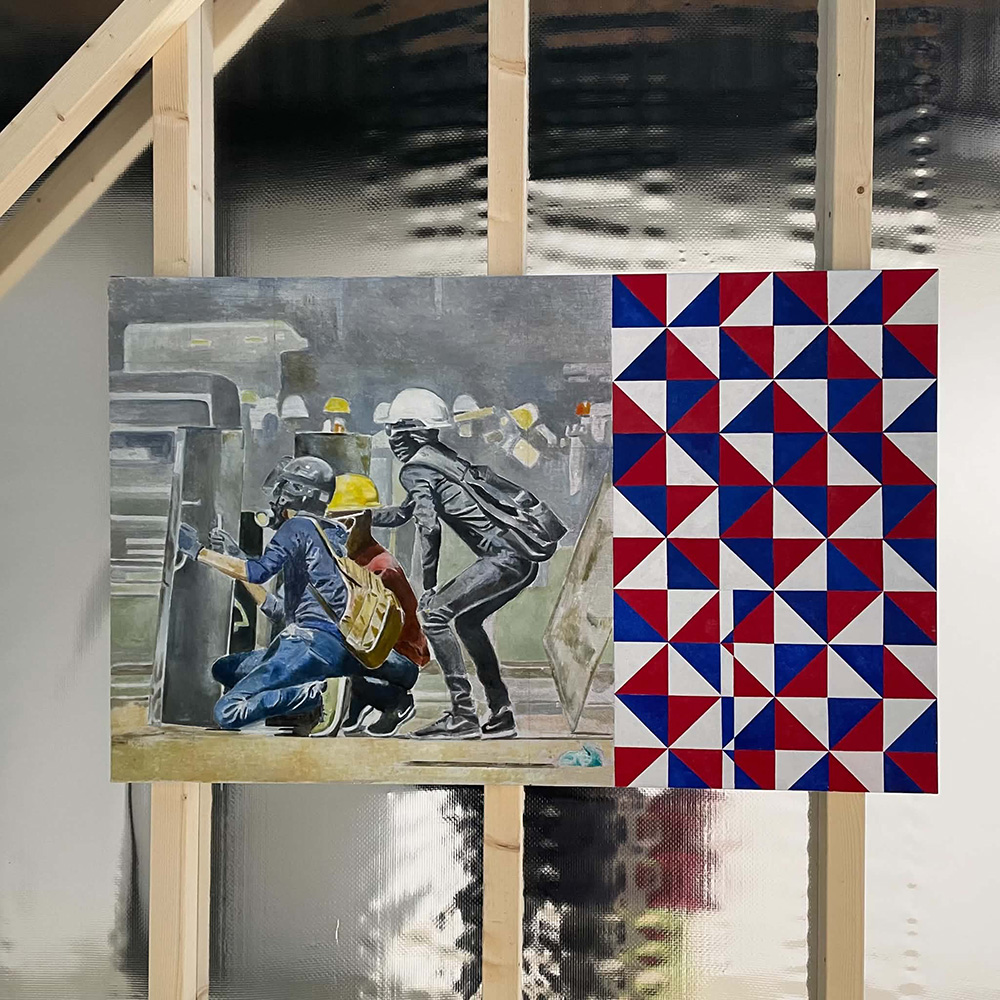
First, the title. People’s Defence Force I–X names an identity the figures have not yet taken. They are protesters. But I wanted the paintings to occupy a temporal space in which the loss of identity has already started. The figures are at the threshold, between civilian protest and armed resistance, between one identity and another.
In the tradition Žižek draws from Hegel and Lucan, an act retroactively creates the conditions in which it can be understood. It cannot be predicted. It can only be recognised after the crossing, once it has changed the person who performed it.12 So I do not think the paintings can show the act itself. What they can show is the condition of it: a person who has been scraped clean of the old fantasy, and who now stands in front of the possibility of death.
Second, the garment pattern. In each painting a corrupted version of it appears alongside the figures. It is a visual trace of the tactic, of the hpone belief, and of the way a patriarchal order can be turned against itself. I do not want to resolve whether the corruption means the belief is breaking or still holding.
Third, I want to say what the paintings are not. They are not illustrations of the revolution. They do not tell the viewer what the crossing will become. I am not interested in a story of heroic sacrifice, Revolutionary suicide, in Newton’s sense, is not martyrdom. The figures do not want to die. They are refusing the life under Military Rule.
These paintings are part of the political project they depict. They are an attempt to capture the struggle of a people determined to end military rule and reclaim their political future. They are made from outside, by someone who did not cross. I cannot pretend otherwise, and I think that should be said.
The current situation in Burma remains difficult to analyse, let alone predict. The phrase Which Way to Land?, which I have used in my work, describes the country’s predicament. Burma is engulfed in a brutal civil war, and the eventual outcome remains uncertain.
The conflict has reached a military stalemate in which the balance of power is divided between the military and the opposition, but neither group appears likely to deliver a knockout blow . The military regime persists in using divide-and-rule tactics, establishing local ceasefire arrangements, and attempting to compel groups become pro regime militias. These strategies seek to fragment opposition and consolidate military control, particularly in the country’s borderlands where Naypyidaw has had some success in getting neighbouring nations to block armed groups from resupplying themselves militarily. Will the Spring Revolution ultimately succeed in toppling the military regime? At this point, only time will tell. My father once told an interviewer back in 1974 when he was a senior figure in the Shan armed struggle, “All power is now in the hands of the soldiers. In a military regime, you either become a lifeless lump of flesh or you fight.” That was during the time of Ne Win, but more than 50 years later a lot of things in Burma are the same now as they were then. International responses to the conflict also raise difficult questions. Strategic and economic interests, particularly the Trump administration’s apparent fixation with obtaining ’ access to Burma’s lucrative rare-earth deposits, risk influencing how external powers engage with the military regime. Meanwhile, drone warfare has become an increasingly significant feature of the conflict, with both sides employing these technologies. Yet in much of the Western media, coverage of Burma often focuses on scam centres and transnational criminal networks, while the military’s continuing bombardment of civilian areas and the killing and displacement of civilians receive far less sustained attention. This imbalance contributes to skewed image of what is occurring on the ground, where the of the country’s ongoing humanitarian catastrophe, is largely overlooked.
More recently, the military regime held a ludicrously sham election, seeking to establish a veneer of civilian legitimacy under Min Aung Hlaing’s leadership. The question of how ASEAN member states and other international actors respond to this political manoeuvre remains central to the struggle over the country’s future.
The crisis in Burma also raises broader questions about the international liberal order. As the global political landscape becomes increasingly illiberal, the principles of democracy, human rights, and accountability are being weakened by geopolitical calculations and strategic interests. Britain, the former colonial power, has imposed several rounds of sanctions on the junta since the coup. Yet Burma Campaign UK has exposed how British ministers hosted a junta representative at official meetings in London, which it calls a significant shift in approach, and that the UK is quietly normalising relations with a regime seeking legitimacy. In my own country of Canada, similairy the Foreign Minister, has hobnobbed with the Min Aung Hlaing’s charge d’affaire in Ottawa. The meetings were made public by the junta, not by the British and Canadian governments. Burma is part of this wider crisis. If the military regime cannot be held accountable for its actions, the consequences extend beyond the country’s borders, undermining the very principles that the international order claims to defend.
Ultimately, People’s Defence Force I–X is both a question about Burma’s uncertain future and a broader reflection on political displacement, resistance, and the search for a place in which people can live with dignity and freedom.
Does the new identity open up a possibility, or does it merely give another name to the conditions that produced it? Does the htamein mark the breaking of a belief, or its confirmation? What does it mean to enter a non-state armed group when doing so offers no guarantee of safety, freedom, or even the possibility of sustaining a life?
I do not think these questions need to be resolved for the argument to hold. What matters is the movement between them: the collapse of a belief in the state, the body left exposed in the absence of its protection, and the choice that follows. Joining the armed struggle does not resolve this exposure. It means entering another uncertain condition, where the possibility of acting against oppression exists alongside the constant risk of losing one’s life.
The people in these paintings made that choice. They did not wish to die. They wanted to see the earth before the end of the world.
Sawangwongse Yawnghwe
Sawangwongse Yawnghwe is an acclaimed artist from Myanmar/Burma who is exiled in The Netherlands. Raised and educated in Vancouver, Canada, Sawang was born into a prominent family of political leaders and Canada-based revolutionary Shan exiles. His grandfather Sao Shwe Thaike was the first President who co-founded the Union of Burma, alongside General Aung San and Prime Minister U Nu. Yanwghwe Sr. was a co-signatory and the principal host of the Panglong Treaty (1947), on the basis of which the modern Burma was established as an independent post-colonial federal union of equal ethnic groups. His own father the late Dr Chao Tzang Yawnghwe, the author of The Shan of Burma: Memoirs of a Shan exile (1987) and a commander of the Shan State Army who fought against General Ne Win’s ethno-supremacist dictatorship (1962-88).
https://www.tkgplus.com/en/artists/31-/biography/
We ran a 3-part series of of the author’s uncle previonsly. Read here:
- Newton, Revolutionary Suicide, 1973 P. 4-5
- Zalloua, Fanon, Žižek, and the Violence of Resistence, 2025 p.116
- Fanon, The Wretched of the Earth, 1961, “ National liberation, national renaissance, the restoration of nationhood to the people, the commonwealth: whatever may be the headings used or the new formulas introduced, decolonisation is always a violent phenomenon”
- Fanon, The Wretched of the Earth, P.1
- Zalloua, Fanon, Žižek, and the Violence of Resistence, 2025 p.113
- Žižek and Daly, Conversation with Žižek, p.121
- Fanon, The Wretched of the Earth, P.2
- My conversation with Maung Zarni
- Zalloua, Fanon, Žižek, and the Violence of Resistence, 2025 p.116
- Zalloua, Fanon, Žižek, and the Violence of Resistence, 2025 p.116
- Echoing the Afropessimists, Fred Moten defines the “abolition of sovereignty” as “an abolition of a certain horrible and brutal individuated notion of freedom. And it’s an abolition of the world that is constructed on that conceptual framework. And if you want to put it in positive rather than negative terms, then it is the project of saving the earth. Or, as the great poet Ed Roberson would say, ‘the project of seeing the Earth before the end of the world” (Nehal El-Hadi, “Ensemble: An Interview with Dr. Fred Moten,” Mice Magazine, Summer 2018. https:// micemagazine.ca/issue-four/ensemble-interview-dr-fred-moten).
- Drawing on Žižek’s Hegelian-Lacanian conception of the authentic act, an act does not simply actualise an already existing possibility. Rather, it retroactively creates its own conditions of possibility. What appeared impossible before the act becomes intelligible in its aftermath. The act cannot be fully understood or anticipated from within the symbolic coordinates that preceded it; it transforms those very coordinates (Žižek, The Courage of Hopelessness, 2017, p. 121).
